When I encounter difficulties, I often turn to Claude for help, but these conversations easily turn into mere comfort and boundless divergence. These prompts perfectly help me jump out of my current narrative perspective and inject unexpected energy into me.
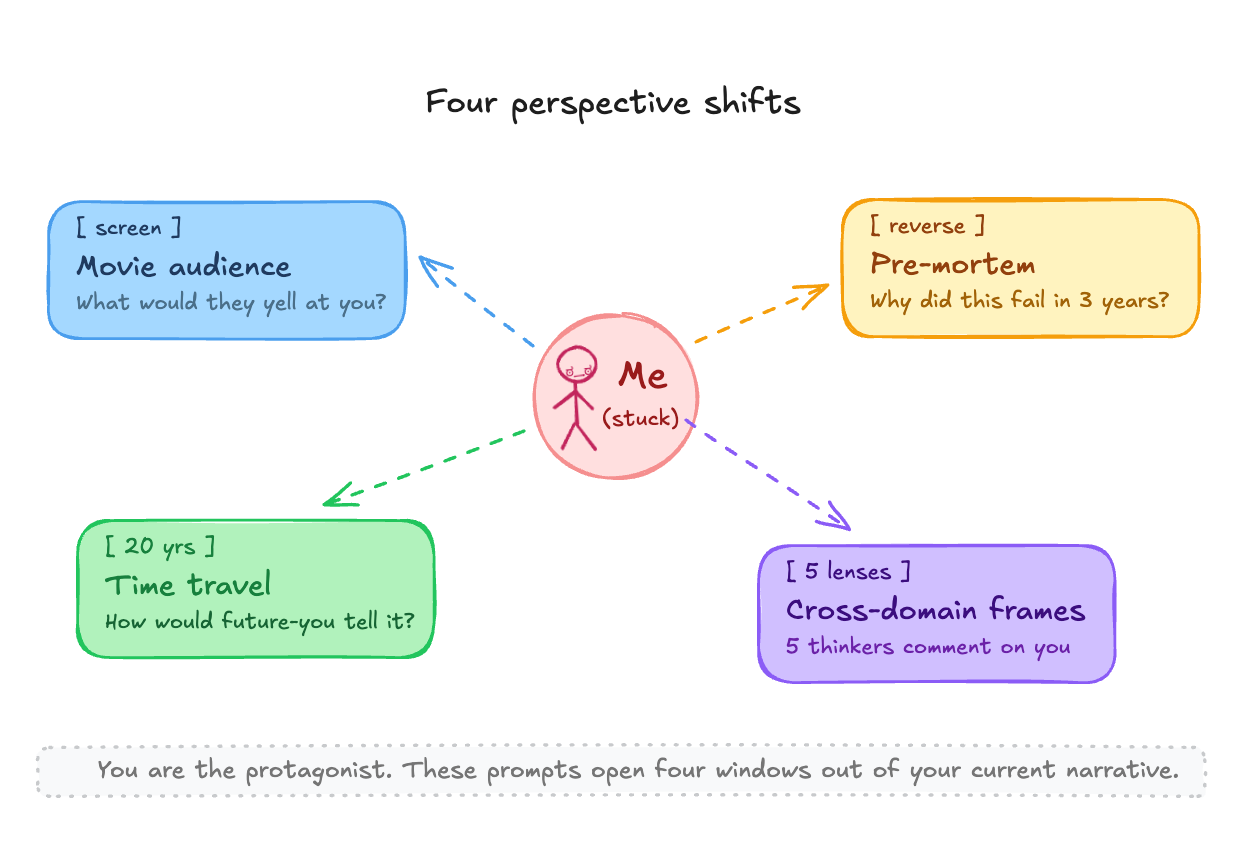
Four Perspective Shifts
Movie Audience
"If my life were a movie, and an audience member were watching this exact scene, what is the one sentence they would want to scream at the screen to me?"
We've all had this experience: when watching a movie or reading a book, when the protagonist veers off track, we worry about their fate and desperately want to jump into the screen and yell: "Explain the misunderstanding, don't let her go!", or "At a time like this, stop dwelling on this petty stuff!". Once AI understands our confusion and experiences, using this prompt for a perspective shift beautifully simulates a unique vantage point: what would someone who genuinely cares about me as a protagonist be anxious about for my sake?
Recently, I saw an interview where Liu Yang told Luyu that when encountering immense pain in life, he tells himself: "This is the beginning of an inspiring story." This is a shift in mindset that helps us regain our sense of conviction as the protagonist of our story.
Pre-mortem
"In 2-3 years, this thing I'm repeatedly agonizing over ultimately failed, or proved to be unimportant. The failure was most likely not due to lack of ability, but rather which three behaviors or assumptions that I have rationalized?"
This prompt is an application of Munger-style reverse thinking. Charlie Munger has a famous quote: "Invert, always invert." Under linear thinking, it's hard to see one's own problems. We always think about how to succeed, but it's better to think about why we might fail.
When discussing personal problems with AI, it is very good at comforting and encouraging, but unless actively requested, it won't stand on the opposite side to help you imagine failure and blind spots. This prompt actively asks AI: help me see the truths I don't want to admit. Seeing your blind spots in advance gives you a chance to avoid real failure; this is also the "pre-mortem" method often used by a16z.
Cross-field Framework
"Based on your understanding of my situation, please match 5 notable figures from different fields, each with a unique interpretive framework. Imagine a passage in their works mentions me. The evaluation can be positive, neutral, or negative — please present these 5 insightful perspectives."
The core of this prompt is cognitive diversity. People from different fields use completely different frameworks to understand the same thing. During long chats with Claude, once my problem is fully understood by it, finding the most "targeted" people and theoretical frameworks for analysis brings me a profound and diverse experience.
In a conversation about "the difficulty of balancing content depth," I tested this prompt. Claude simulated Susan Sontag's perspective to critique me:
Profound content can also be conveyed through light forms. If a creator cannot find an elegant audio-visual language for profound insights, it is not because she is overly loyal to reality, but because her creative mind is not yet mature.
Time Shift
"In 20 years, I meet an old friend I haven't seen for years at a college reunion. How would I describe this hurdle I couldn't get over at this stage, and how I got through it? Stretching out the timeline and looking back from after monumental shifts in the era, how would I evaluate my situation and choices?"
We've heard this truth countless times: what feels like a massive deal right now is just a small ripple when stretched to a lifelong perspective. But having Claude actually simulate a slice of the future and place it before me gives a feeling of instantly "flattening" my current anxiety.
Having Claude help me "meet versions of myself from different times", simulate what I would say then, or even having it write my speech 10 years from now or this specific chapter in my autobiography, are all very fun perspective shifts. It's a protagonist-like global perspective that reminds us the predicament itself is part of the process, we won't be defeated, and the story is still long.
How to use
- Open a chat where you've talked with AI about your confusions, experiences, or reflections.
- Or, first describe a problem currently bothering you.
- Paste one of the prompts and send it.
You will then see the AI's response from different perspectives.
Creating Perspectives for AI
These are all thinking methods I encountered in fragmented reading; the first is from Sahil Bloom, the second is Munger's reverse thinking. During casual fragmented reading, we often have that internal realization of "this is a clever way to think," and then nothing happens, at most it collects dust in our bookmarks. But now, whether it's serious philosophy or internet chicken soup, as long as I want to try it, I can turn it into a prompt to "experience" it, look at myself from different perspectives, and shape a pluralistic understanding of things. It's like accumulating phrases when learning English; when you consciously use these ways of thinking, you shorten the link between learning and applying as much as possible. This way, fragmented reading isn't just about "knowing," it truly becomes a tool that helps you solve problems.